AECT Standard 4: Professional Knowledge and Skills

Candidates design, develop, implement, and evaluate technology-rich learning environments within a supportive community of practice.
Indicators:
- S.4.1 Collaborative Practice – Candidates collaborate with their peers and subject matter experts to analyze learners, develop and design instruction, and evaluate its impact on learners.
- S.4.2 Leadership – Candidates lead their peers in designing and implementing technology-supported learning.
- S.4.3 Reflection on Practice – Candidates analyze and interpret data and artifacts and reflect on the effectiveness of the design, development, and implementation of technology-supported instruction and learning to enhance their professional growth.
- S.4.4 Assessing/Evaluating – Candidates design and implement assessment and evaluation plans that align with learning goals and instructional activities.
- S.4.5 Ethics – Candidates demonstrate ethical behavior within the applicable cultural context during all aspects of their work and with respect for the diversity of learners in each setting.
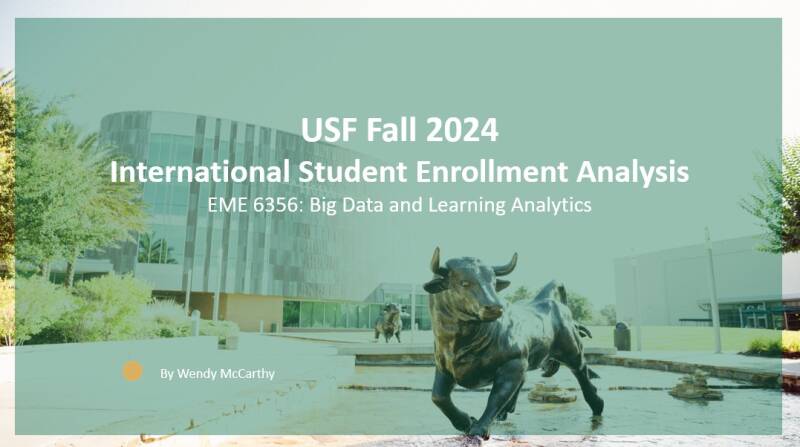
USF Fall 2024 International Student Enrollment Analysis
Course: EME 6356 Big Data and Learning Analytics, Summer 2025
Artifact Details
- Purpose and Nature of the Artifact: This artifact is a comprehensive institutional data analysis report and an accompanying visual presentation titled "USF Fall 2024 International Student Enrollment Analysis". Developed for EME 6356: Big Data and Learning Analytics in Summer 2025, its purpose is to evaluate a complex, macro-level university ecosystem by examining demographic and enrollment data for 5,401 international students. The project identifies critical vulnerabilities, such as regional overdependence and resource imbalances, to establish data-driven operational frameworks that optimize institutional learning environments.
- Description of the Design Development Process: Working independently, I managed the entire data lifecycle from ingestion to strategic reporting. I gathered internal data from the University of South Florida's Office of Admissions, Office of International Services, and USF World. To ensure analytical rigor, I executed a three-phase data cleaning procedure that involved standardizing inconsistent country names against ISO codes, correcting typographical and temporal errors, and aligning academic level categorizations across separate spreadsheets. Utilizing SPSS, I designed a multi-layered statistical analysis plan incorporating descriptive statistics, cross-tabulations, custom-calculated disparity indices, and Pearson Chi-Square tests to validate enrollment skews. Finally, I translated these complex data points into a high-contrast visual slide deck featuring clean charts, regional data tables, and geographic heat maps to make the findings highly accessible to university administrators.
-
Explanation of How the Artifact Demonstrates the Sub-Standards:
- S.4.1 Collaborative Practice: I demonstrated collaborative practice by working with data from multiple campus offices, including the Office of International Admissions, the Office of International Services, and USF World. By comparing and analyzing these datasets, I examined the international student population and evaluated how enrollment trends may affect student support services.
- S.4.2 Leadership: I demonstrated leadership by analyzing institutional data and developing practical recommendations to support student success. Based on the findings, I proposed the development of a technology-supported Diversity Equity Dashboard to help monitor enrollment and retention trends over time.
- S.4.3 Reflection on Practice: This artifact reflects my ability to examine institutional data and identify areas for improvement. Through data analysis, I identified challenges such as a 75.4% country concentration risk and capacity limitations in high-demand STEM programs. These findings helped me better understand institutional needs and informed recommendations for future planning and resource allocation.
- S.4.4 Assessing/Evaluating: I demonstrated assessment and evaluation skills by conducting a statistical analysis aligned with the university's strategic goals. I organized major fields into STEM and non-STEM categories, performed frequency distribution analyses, and conducted Chi-Square tests to evaluate regional differences within the student population.
- S.4.5 Ethics: This artifact demonstrates an ethical approach to educational planning by focusing on the needs of diverse student populations. Using research and enrollment data, I examined factors that may contribute to student attrition and proposed equitable initiatives, such as the Global Impact Scholarship and Global Peer Connect program, to support student success, promote inclusion, and respect cultural diversity.
-
Competencies and Skills Gained: Through this project, I advanced my competencies in institutional data cleaning, professional data visualization workflow, SPSS statistical procedures (Crosstabs, Frequencies, Chi-Square testing, and variable recoding), custom demographic disparity indexing, educational risk assessment, and data-driven strategic leadership.
-
Role and Specific Contributions: This was an entirely independent project. I acted as the sole Data Analyst, Principal Investigator, and Presenter. I was individually responsible for extracting and cleaning the master dataset, executing all mathematical and statistical calculations, designing the tables and charts, writing the comprehensive evaluative narrative, and formulating the macro-level policy and funding recommendations to support long-term student integration.

Scenario-Based Instructional Design: The Bulls AI Career Agency Online Course
Course: EME 6613 Development of Tech-Based Instruction, Spring 2026
Artifact Details
- Purpose and Nature of the Artifact: This artifact consists of a comprehensive final reflection paper and an accompanying interactive eLearning module titled "The Bulls AI Career Agency: Your 30-Minute Fair Prep". Developed for EME 6613: Development of Tech-Based Instruction in Spring 2026, this scenario-based digital learning asset was built using Articulate Storyline 3 to serve undergraduate students at the University of South Florida (USF). The primary purpose of the module is to bridge the gap between career readiness and AI literacy by immersing students in a realistic simulation at the USF Marshall Student Center virtual career fair, allowing them to ethically practice AI prompt engineering and identify algorithmic hallucinations in a low-stakes environment.
- Description of the Design Development Process:
I managed the design, development, and evaluation of this instructional module using a design based research approach. The project was guided by Sweller's Cognitive Load Theory, Lave and Wenger's Situated Learning Theory, and Kolb's Experiential Learning Theory to create an authentic and engaging learning experience. The prototype was evaluated in three phases. First, four USF professionals completed a subject matter expert review to assess content accuracy and alignment. Second, five undergraduate students participated in think aloud usability testing to identify navigation issues and improve the learner experience. Third, the module was deployed online for beta testing with 10 USF Admissions student workers, followed by a focus group discussion. I analyzed both quantitative and qualitative feedback, including Likert scale ratings and participant comments, to guide revisions and improve the final product.
-
Explanation of How the Artifact Demonstrates the Sub-Standards:
- S.4.1 Collaborative Practice: I demonstrated collaborative practice by working with peers and university subject matter experts. I organized and facilitated an expert review with four USF professionals from academic advising, program administration, and admissions to evaluate the accuracy and relevance of the learning activities and career preparation scenarios.
- S.4.2 Leadership: I demonstrated leadership by planning, implementing, and managing the beta test with 10 USF Admissions student workers. I also facilitated a focus group through Zoom, gathered participant feedback, and used the results to guide improvements to the module.
- S.4.3 Reflection on Practice: This artifact demonstrates reflective practice through the analysis of user feedback and performance data. While participants reported strong career confidence, prompt writing confidence was lower, and some learners found the FAQ section too lengthy. These findings helped identify areas for improvement and informed future design decisions.
- S.4.4 Assessing and Evaluating: I developed and implemented a multi-phase evaluation plan that included expert reviews, think aloud usability testing, beta testing, and a post module survey. I analyzed both quantitative and qualitative data to evaluate learner reactions, perceived learning outcomes, and overall usability.
- S.4.5 Ethics: This module demonstrates ethical practice by teaching learners how to identify AI hallucinations and evaluate the accuracy of AI generated content. The design also encourages responsible AI use by presenting AI as a learning and productivity tool while promoting academic integrity and respect for diverse learner perspectives.
-
Competencies and Skills Gained: Through the execution of this project, I significantly expanded my technical expertise in advanced Articulate Storyline 3 variables and interaction triggers, mixed-methods data triangulation, design-based research frameworks, Braun and Clarke's thematic analysis, Kirkpatrick-aligned evaluation methodology, and the practical application of Quality Matters higher education standards.
-
Role and Specific Contributions: This project was completed as an entirely independent endeavor. I served as the sole instructional designer, multimedia developer, principal investigator, and data analyst. I was exclusively responsible for researching and scripting the narrative characters, programing the interactive Storyline mechanics (such as the Drag-and-Drop modules and the Prompt Builder interface), authoring all evaluation data collection instruments, running the data analysis, and performing the final software revisions to maximize real-world skill transfer.

ADHD Family Resource Hub: A Hybrid Project Management Approach
Course: EME 6235 Technology Project Management, Fall 2025
Artifact Details
- Purpose and Nature of the Artifact: This artifact consists of a comprehensive project management blueprint and documentation titled "ADHD Family Resource Hub: A Hybrid Project Management Approach," developed for EME 6235: Technology Project Management in Fall 2025. The primary purpose of this artifact is to outline the digital transformation of student support services within Pasco County Schools. It establishes the framework for a centralized, 24/7 digital website hub hosted on district infrastructure that consolidates scattered, isolated, and analog ADHD resources into a single, searchable, and legally compliant repository for K-12 families, educators, and community partners.
- Description of the Design Development Process: The development process was structured around a tailored hybrid project management methodology that combined the macro-control of Waterfall milestones with the iterative flexibility of Agile sprint cycles. Spanning a strict 15-week timeline, the project moved systematically through four distinct phases: Discovery & Planning, Design & Prototyping, Development & Population, and Testing & Launch. As the leader of this initiative, I established SMART objectives and developed a comprehensive project communication plan using Asana for task tracking, Figma for UI and UX design, and Microsoft Teams for communication and project coordination. To support successful implementation, I aligned the project with the existing Student Support Programs and Services (SSPS) department structure and created a formal change management process to monitor project requests and minimize scope creep.
-
Explanation of How the Artifact Demonstrates the Sub-Standards:
- S.4.1 Collaborative Practice: I demonstrated collaborative practice by architecting a cross-functional project alignment structure that integrated expertise across multiple district units, including ESE Specialists, MTSS teams, Mental Health Units, and school-based frontline practitioners. I built a bi-weekly asynchronous review cadence specifically for Subject Matter Experts (SMEs) to continuously verify and curate the clinical and educational accuracy of the hub's web content.
- S.4.2 Leadership: I demonstrated leadership by serving in the dual role of Project Manager and Content Creator (PM/CC). In this role, I led the project team, including the Web Designer, Developer, and Quality Assurance Tester. I facilitated decision making through structured consensus building methods such as Weighted Dot Voting and Fist of Five. I also promoted open communication and collaboration to address team challenges and keep the project on schedule.
- S.4.3 Reflection on Practice: This artifact demonstrates deep reflection by evaluating the structural advantages of the hybrid management approach against the fixed constraints of an academic calendar. In the closeout documentation, I critically analyzed the project's limitations, identifying the strategic need to extend future beta testing phases to a wider, more diverse pool of families and recommending the immediate embedding of real-time post-launch feedback mechanisms.
- S.4.4 Assessing/Evaluating: I engineered a robust evaluation plan that established measurable key performance indicators (KPIs) to track project success and operational health. This framework aligned instructional activities with specific, data-driven targets, including achieving a 100% WCAG 2.1 AA accessibility passing rate, maintaining a 90% on-time milestone delivery rate, securing an 85% first-pass stakeholder approval rate, and leveraging district data teams to track long-term impact metrics like unique resource downloads and annual parent surveys.
- S.4.5 Ethics: This project models high ethical standards by prioritizing digital inclusion as an internationally recognized benchmark for equity, mandating 100% technical compliance with Web Content Accessibility Guidelines (WCAG) 2.1 AA using professional screen-reader software like JAWS. Furthermore, I demonstrated respect for student diversity by allocating resources for a curated library of 80–100 culturally sensitive images reflecting the community and designing the infrastructure to scale for future multi-language expansions.
-
Competencies and Skills Gained: Through the development of this project, I gained advanced skills in project planning, instructional content development, accessibility focused design, risk management, and program evaluation. I also strengthened my ability to apply project management principles, develop measurable performance indicators, conduct audience analysis, and design practical solutions for educational settings.
-
Role and Specific Contributions: I served as the sole Project Manager and Content Creator for this project. I was responsible for all aspects of planning, design, and documentation, including developing the project charter, conducting audience and needs analyses, synthesizing CDC guidelines into family friendly content, creating the site structure and content plan, developing the project budget and timeline, establishing evaluation measures, and preparing implementation recommendations. I independently managed the project from initial concept through final presentation.
Create Your Own Website With Webador