AECT Standard 2: Content Pedagogy

Candidates develop as reflective practitioners who are able to demonstrate effective implementation of educational technologies and processes based on contemporary content and pedagogy.
Indicators:
- S.2.1 Creating – Candidates apply content pedagogy to create appropriate applications of processes and technologies to improve learning and performance outcomes.
- S.2.2 Using – Candidates implement appropriate educational technologies and processes based on appropriate content pedagogy.
- S.2.3 Assessing/Evaluating – Candidates demonstrate an inquiry process that assesses the adequacy of learning and evaluates the instruction and implementation of educational technologies and processes grounded in reflective practice.
- S.2.4 Managing – Candidates manage appropriate technological processes and resources to provide supportive learning communities, create flexible and diverse learning environments, and develop and demonstrate appropriate content pedagogy.
- S.2.5 Ethics – Candidates design and select media, technology, and processes that emphasize the diversity of our society as a multicultural community.
Principles for Reducing Extraneous Processing in Multimedia Learning
Course: EME 6208 Interactive Media, Fall 2024
Artifact Details
- Purpose and Nature of the Artifact: This artifact is a video presentation titled "Principles for Reducing Extraneous Processing in Multimedia Learning", created for EME 6208 Interactive Media in Fall 2024. Its purpose was to analyze and explain core cognitive load theory and instructional design frameworks that help educators optimize digital learning materials.
- Description of the Design Development Process: I began by researching Mayer’s multimedia learning principles, focusing on strategies that reduce cognitive overload for learners. I then drafted a script and designed presentation slides that intentionally modeled these principles, ensuring alignment between visuals and narration. Finally, I used video recording software to produce the presentation, carefully managing pacing, audio quality, and visual clarity to deliver an effective instructional resource.
-
Explanation of How the Artifact Demonstrates the Sub-Standards:
-
S.2.1 Creating: I applied instructional design principles by developing a multimedia presentation that intentionally aligns visuals and narration to reduce cognitive load and improve learning outcomes.
-
S.2.2 Using: I implemented video recording and presentation tools grounded in multimedia learning principles to effectively deliver instructional content.
-
S.2.3 Assessing Evaluating: This presentation demonstrates reflective evaluation by analyzing the effectiveness of multimedia design and identifying how instructional choices impact cognitive load and learner understanding.
-
-
Competencies and Skills Gained: Through this project, I strengthened my skills in video production, instructional design, presentation development, cognitive load theory application, and multimedia learning design.
-
Role and Specific Contributions: This was an individual project. I was solely responsible for researching the theoretical concepts, writing the script, designing the slides, recording the video, and completing the final review.
A Vision for Artificial Intelligence in Education (AIED)
Course: EME 6055 Current Trends in Instructional Technology, Fall 2024
Artifact Details
- Purpose and Nature of the Artifact: This artifact consists of a research paper and an accompanying video recording presentation titled "A Vision for Artificial Intelligence in Education (AIED)" developed for EME 6055 Current Trends in Instructional Technology in Fall 2024. Its purpose is to investigate how artificial intelligence–enabled personalized learning can transform higher education workflows and optimize instructional delivery for both students and faculty.
- Description of the Design Development Process: Working as a reflective practitioner, I conducted an extensive literature review on modern educational challenges, shifting career pathways, and emerging technological applications. I organized the content to map artificial intelligence technologies against foundational learning theories, including behaviorism, cognitivism, and constructivism. After drafting the scholarly paper, I developed a video presentation, synthesizing complex topics such as machine learning, natural language processing, and adaptive learning systems into a highly visual instructional format.
-
Explanation of How the Artifact Demonstrates the Sub-Standards:
- S.2.1 Creating: I applied contemporary instructional design principles by developing a framework that maps Keller’s ARCS Model to artificial intelligence capabilities, demonstrating how adaptive design can enhance motivation and performance outcomes.
- S.2.2 Using: I analyzed and modeled the implementation of educational technologies such as intelligent tutoring systems and adaptive learning platforms to support personalized instruction.
- S.2.3 Assessing Evaluating: This project demonstrates an inquiry-based approach by evaluating major paradigms of artificial intelligence in education and reflecting on data-driven models of instructional effectiveness.
- S.2.4 Managing: I explored strategies for managing instructional processes and learning environments that support flexible, interdisciplinary, and technology-enhanced education.
- S.2.5 Ethics: This project emphasizes ethical and inclusive design by examining how artificial intelligence can support equity, accessibility, and culturally responsive learning in diverse educational settings.
-
Competencies and Skills Gained: Through this project, I strengthened my skills in academic research writing, instructional video design, data-informed analysis, ethical evaluation of emerging technologies, and the application of learning theories to AI-based systems.
-
Role and Specific Contributions: This was an individual project. I was fully responsible for literature research, writing the paper, developing the instructional narrative, producing the video presentation, and ensuring all academic standards and citations were properly applied.
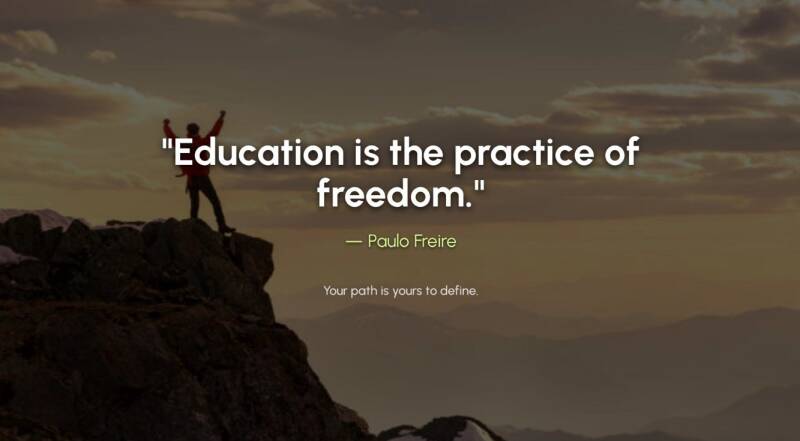
Define Your Path
Learning Beyond the Classroom
Course: EME 6347 Digital Media and Learning, Fall 2025
Artifact Details
- Purpose and Nature of the Artifact: This artifact consists of a presentation, speaker script, and self-reflection exploring the educational philosophies of Paulo Freire and Ivan Illich. The project examines Freire’s concept of the "banking model” of education and applies the theme "Define Your Path: Learning Beyond the Classroom.” Its purpose is to transform a traditional college recruitment presentation into an ethical, critical pedagogical learning experience that empowers prospective high school students to become active co-investigators of their own education.
- Description of the Design Development Process: I began by analyzing the limitations of traditional standardized education models, focusing on how rigid classroom structures can promote student passivity. I developed a learning pathway grounded in critical pedagogy, contrasting Freire’s banking model with problem-posing education. To translate this theory into digital practice, I integrated Illich’s concept of learning webs to explore how digital tools, skill exchanges, makerspaces, and peer-matching systems can support decentralized learning networks. Finally, I developed a multimedia presentation and instructional script designed to guide learners in mapping interest-driven educational pathways.
-
Explanation of How the Artifact Demonstrates the Sub-Standards:
- S.2.1 Creating: I applied contemporary content pedagogy by designing an alternative educational framework that uses technology to shift learning from passive content consumption to active co investigation. By modeling problem posing principles within a digital presentation design, I constructed an instructional process aimed at improving critical thinking and student performance outcomes.
- S.2.2 Using: I implemented educational presentation tools based on radical educational theories to challenge traditional compliance scripts. I demonstrated how to use technological processes to support student learning by showcasing how modern networks can facilitate peer matching and real time skill exchange outside institutional borders.
- S.2.3 Assessing Evaluating: This project demonstrates an inquiry process by evaluating the adequacy of traditional lecture and test structures through the lens of critical theory. My work evaluates the implementation of digital media by reflecting on how modern web spaces can successfully replace institutional authority with authentic mentorship and collaborative dialogue.
- S.2.5 Ethics: I designed this project to emphasize diverse societal pathways by validating practical, non-academic technical competencies and self-directed vocational skills. By deconstructing the systemic notion that a single corporate path is suitable for everyone, this artifact champions educational equity and respects the diverse economic, social, and cultural backgrounds of learners.
-
Competencies and Skills Gained: Through this project, I strengthened my skills in critical pedagogy analysis, instructional media design, curriculum development for informal learning environments, and sociocultural learning theory application.
-
Role and Specific Contributions: This was an individual project. I was fully responsible for theoretical research, narrative development, visual design, multimedia production, and final presentation delivery.
Create Your Own Website With Webador